

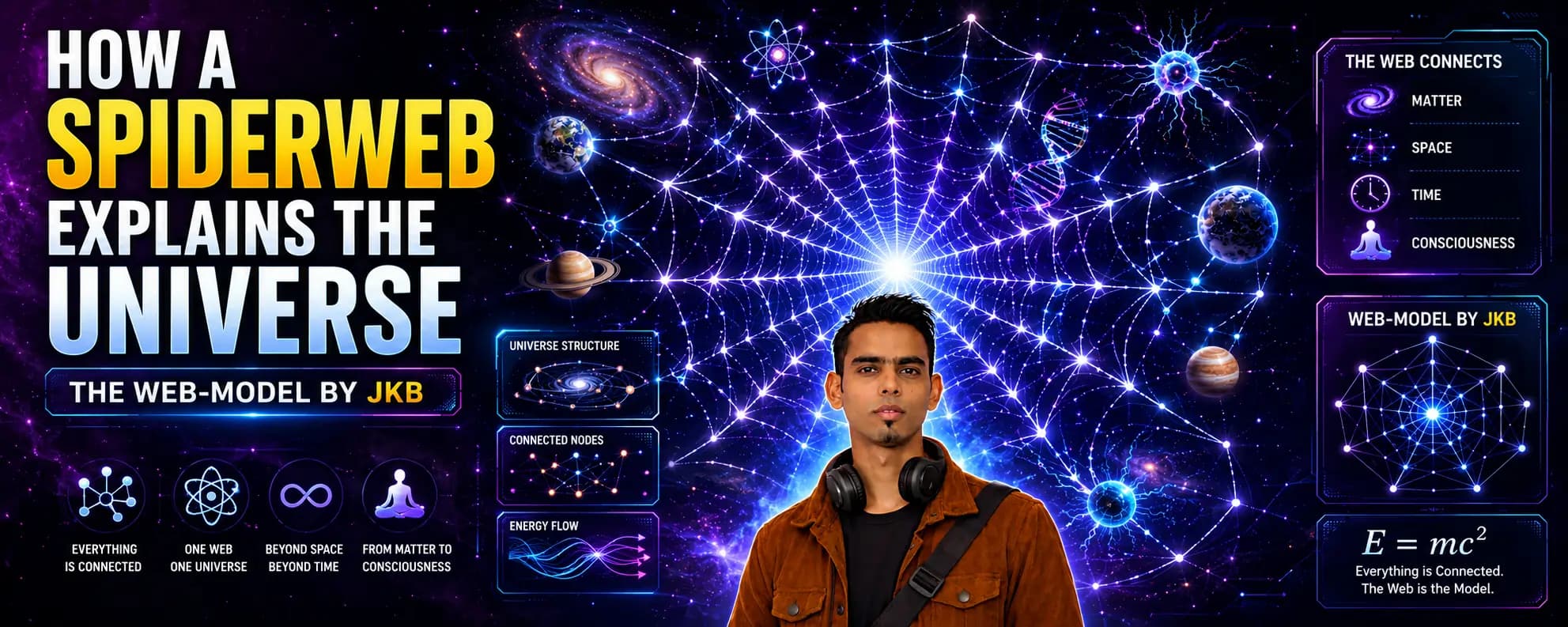
The Web-Model: Study of Solar System and Atomic Structure through Spiderweb Geometry
Researcher / शोधकर्ता: Jitendra K Brajwas
This research highlights the principle of self-similarity (Fractals) existing in nature. It proposes that nature utilizes a similar geometric blueprint to organize structures at both its macro-cosmic scale (the Solar System) and its micro-cosmic scale (the Atom). The structural geometry of a spiderweb provides a live, tangible example of this universal framework. Through the proposed 'Web-Model', complex concepts of astronomy and quantum physics are explored across two distinct domains (Macro & Micro), serving as an intuitive and creative educational tool to help students easily grasp foundational science.
यह शोध प्रकृति में विद्यमान आत्म-समानता (Self-Similarity) के सिद्धांत को उजागर करता है। इसमें प्रस्तावित है कि प्रकृति अपने विस्तृततम रूप (सौरमंडल) और सूक्ष्मतम रूप (परमाणु) के संगठन के लिए एक ही प्रकार के ज्यामितीय पैटर्न का उपयोग करती है। मकड़ी के जाले की संरचनात्मक ज्यामिति इस सार्वभौमिक ढांचे का सजीव उदाहरण प्रदान करती है। प्रस्तुत ‘जाला-मॉडल’ के माध्यम से सौरमंडल और परमाणु की जटिल अवधारणाओं को दो स्तरों (Macro एवं Micro) पर समझने की कोशिश की गई है। यह सरल एवं रचनात्मक शैक्षिक मॉडल छात्रों को खगोल-विज्ञान एवं परमाणु-भौतिकी के मूल सिद्धांतों को सहजता से ग्रहण करने में सक्षम बनाएगा।
1. Hypothesis: Spiderweb Vs Solar System Model / परिचय एवं परिकल्पना
The core objective of this investigation is to demonstrate the concept of self-similarity or fractal geometry in nature through a simple, observable example.
Hypothesis: Nature employs roughly identical geometric arrangements to structure its largest manifestation (the Solar System) and its smallest entity (the Atom). This underlying blueprint is plainly visible in a spiderweb. A spiderweb functions as a natural fractal—where a localized subunit reflects the grander design. This structural repetition can be mapped directly to planetary revolutions and electron shells.
इस शोध का मुख्य उद्देश्य प्रकृति में विद्यमान आत्म-समानता (Self-Similarity) या फ्रैक्टल (Fractal) ज्यामिति के सिद्धांत को एक सहज, दृश्य उदाहरण के माध्यम से समझाना है।
परिकल्पना: प्रकृति अपने विशालतम रूप (सौरमंडल) और सूक्ष्मतम रूप (परमाणु) को व्यवस्थित करने के लिए लगभग समान ज्यामितीय पैटर्न का उपयोग करती है। यह पैटर्न मकड़ी के जाले (spiderweb) में प्रत्यक्ष देखा जा सकता है। मकड़ी का जाला एक प्राकृतिक फ्रैक्टल है – जहाँ छोटा भाग बड़े ढाँचे जैसा दिखता है। यही गुण सौरमंडल (ग्रहों की परिक्रमा) और परमाणु (इलेक्ट्रॉन की कक्षाएँ) में भी देखा जा सकता है।
2. Comparative Analysis / तुलनात्मक विश्लेषण
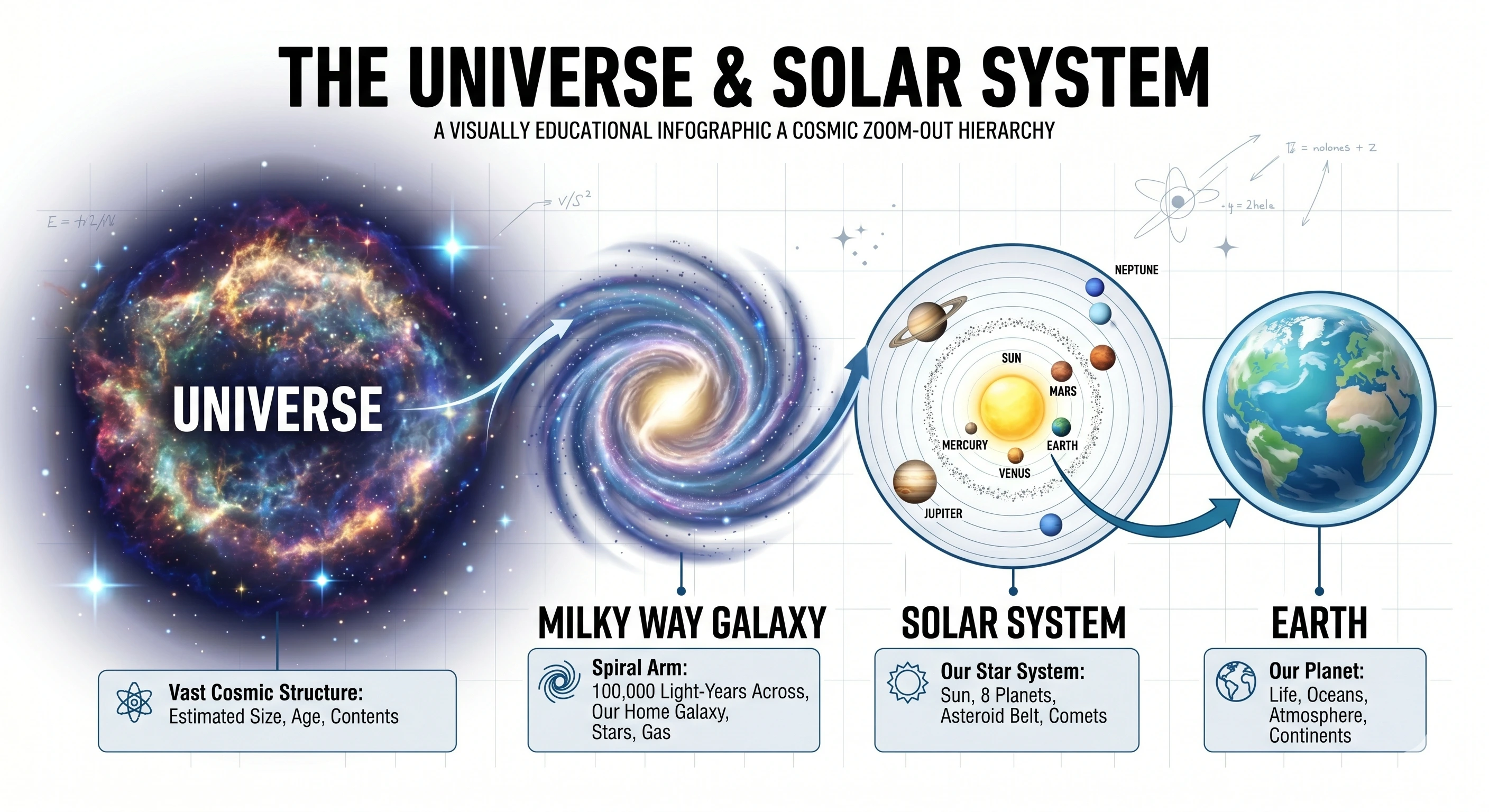
A. The Solar System vs. Spiderweb (Macro Level / स्थूल जगत)
-
Centralization: Just as the Sun sits at the focal center of the solar system, a spiderweb anchors around a distinct central hub to stabilize the entire layout.
-
Orbits & Spacing: The concentric circular threads of the web mirror planetary orbits, providing a simple mental picture of planetary tracks and their relative positioning.
-
Central Force: The gravitational pull exerted by the Sun is analogous to the tensile forces radiating from the center of the web, keeping the structural components unified.
-
Planetary Distance: The systematic spacing between the web's concentric threads aligns symbolically with the arrangement of orbits based on distance from the center.
-
केंद्रीकरण: जिस प्रकार सौरमंडल के केंद्र में सूर्य स्थित है, उसी प्रकार मकड़ी के जाले का भी एक स्पष्ट केन्द्रबिंदु होता है जो पूरे जाले को संतुलित रूप से बांधे रखता है।
-
कक्षाएं और दूरी: मकड़ी के जाले में केन्द्र के चारों ओर फैले वृत्ताकार धागे ग्रहों की परिक्रमाएँ (Planetary Orbits) और उनकी नियत दूरियाँ प्रतीकात्मक रूप से दर्शाते हैं, जिससे ग्रहों के परिक्रमा मार्ग का बोध आसान हो जाता है।
-
केन्द्रीय बल: जैसे सूर्य का गुरुत्वाकर्षण सौरमंडल के सभी ग्रहों को अपनी ओर खींचे रखता है, वैसे ही मकड़ी के जाले में केन्द्र की ओर फैलने वाली तनावकारी शक्ति (tensile force) सम्पूर्ण जाले को एकीकृत और स्थिर बनाए रखती है।
-
ग्रहों के बीच दूरी: जाले के धागों का नियमित अंतराल ग्रहों के बीच की दूरी और उनकी क्रमिक व्यवस्था का एक सरल दृश्य चित्रण प्रस्तुत करता है।
The Seasonal Cycle / ऋतु चक्र का मॉडल
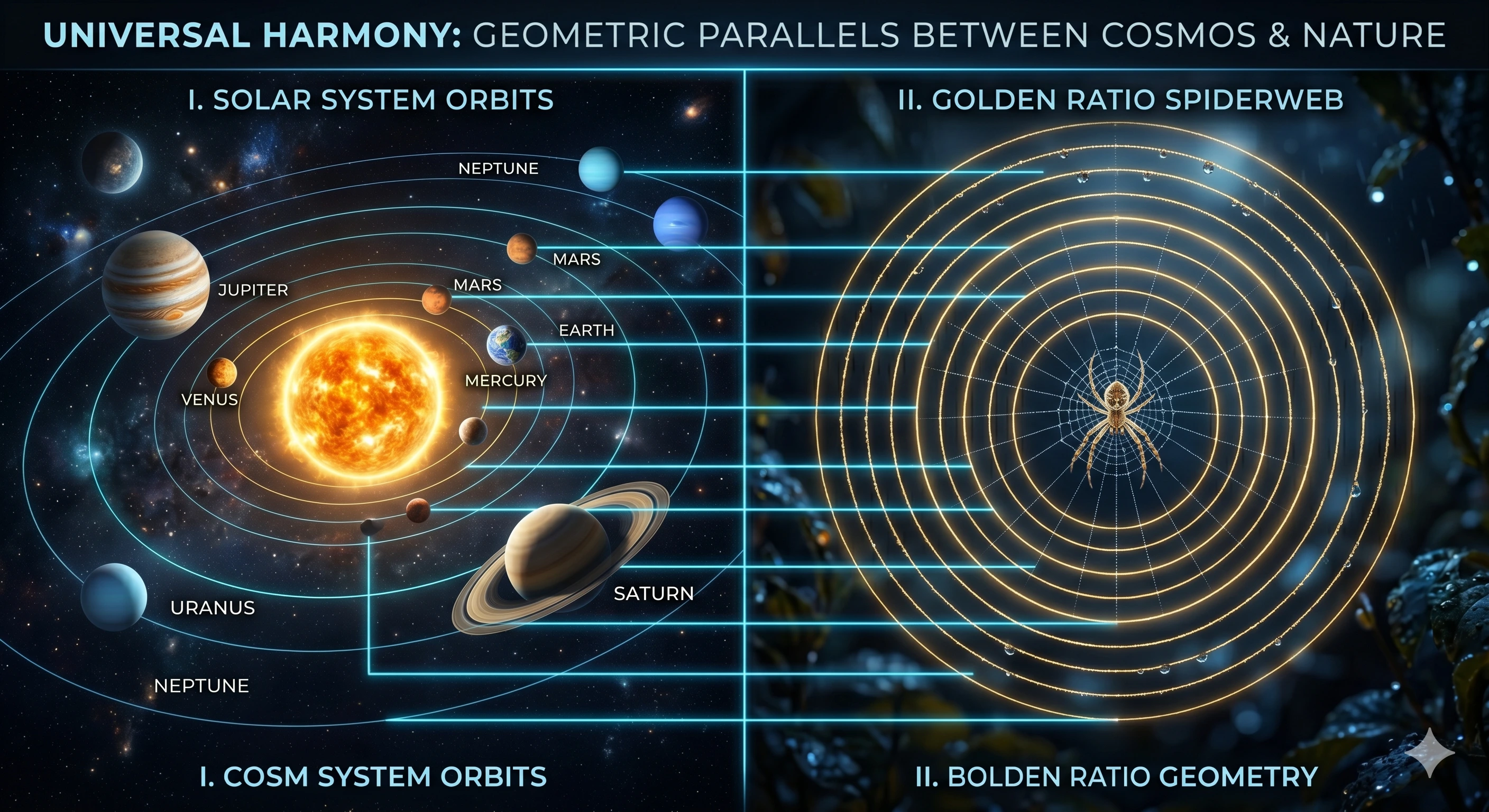
By partitioning the web into 4 quadrant zones (each spanning 90°), the model helps chart Earth's annual revolutionary timeline across four critical geometric markers: the Solstices (Summer/Winter) and Equinoxes (Spring/Autumn).
-
Educational Clarification: While changes in seasons are physically driven by Earth's axial tilt (~23.5°), this geometric web-mapping functions as an excellent educational aid for students to memorize the cyclical timeframe of planetary revolution.
जाले को 4 कोणीय खंडों में बाँटकर (प्रत्येक 90°) पृथ्वी की सूर्य के चारों ओर परिक्रमा के चार मुख्य बिंदुओं – संक्रांति (ग्रीष्म/शीत) और विषुव (बसंत/शरद) के कालखंड को समझाया जा सकता है।
-
स्पष्टीकरण: वास्तविक ऋतुएँ पृथ्वी के अक्षीय झुकाव (~23.5°) से उत्पन्न होती हैं, परंतु जाला-मॉडल छात्रों को परिक्रमण के समय चक्र (Timeline) को याद रखने में सहायता करता है।
B. Atomic Structure vs. Spiderweb (Micro Level / सूक्ष्म जगत)
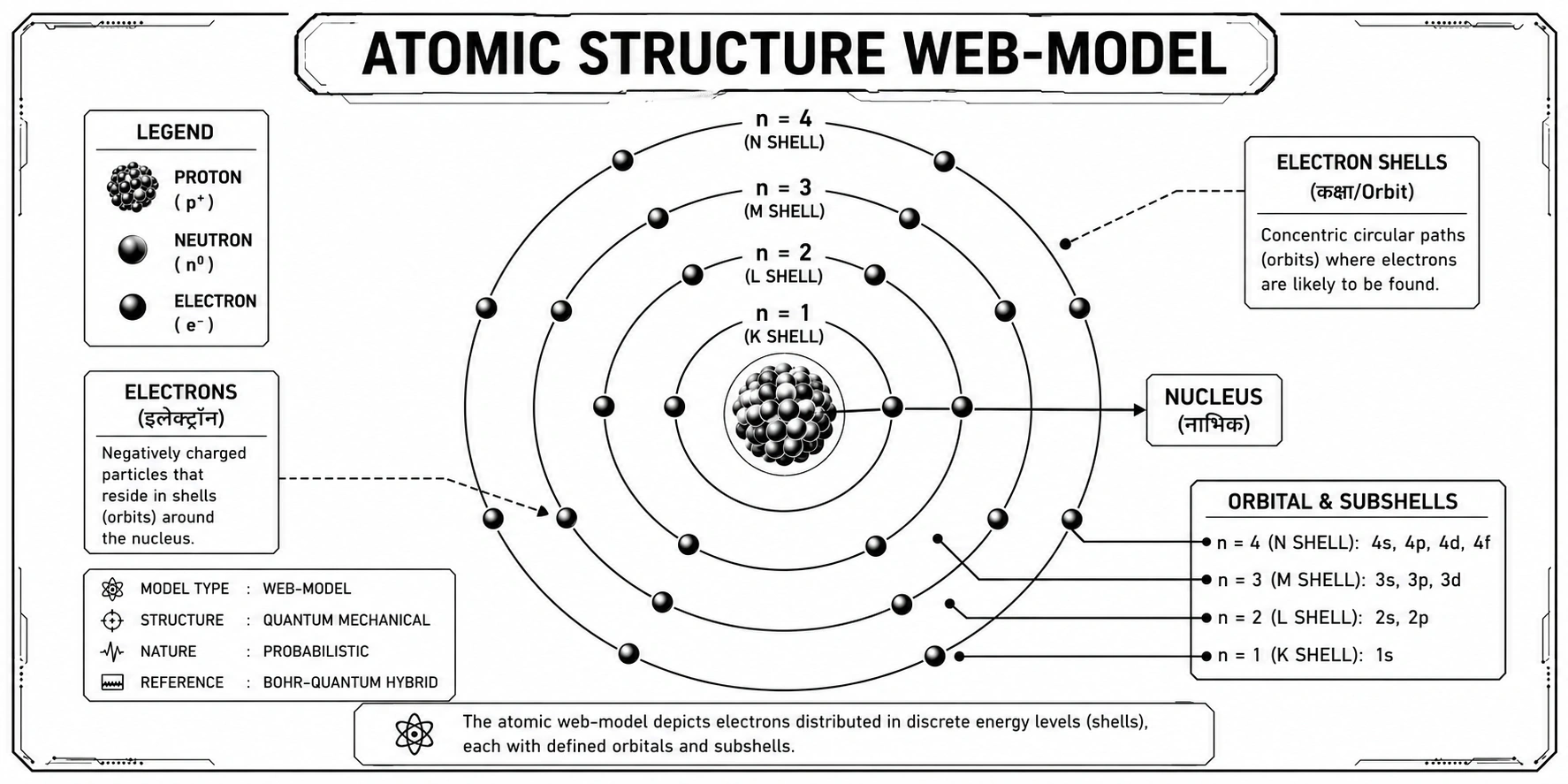
- Nucleus and Shells: The central core of the web aligns with the atomic 'Nucleus' (protons and neutrons), while the outer concentric loops map directly onto discrete electron energy shells ($K, L, M, N$).
- Electron Configuration: As a web expands outward, the gap and thickness of the structural threads shift. This mirrors how an atom's shell capacities and energy tiers evolve further from the nucleus (housing up to 2, 8, 18, 32 electrons across progressive shells).
- Direction of Motion & Spin: The counter-directional alignment of threads during the early phases of web weaving serves as a metaphor for electron directional spin (Up/Down configurations).
- Probability Clouds: The solid silk lines indicate zones of peak probability density (>90%) for finding an electron, whereas the empty interstitial spaces correspond to minimum probability zones.
नाभिक एवं कक्षाएँ: मकड़ी के जाले का केंद्र परमाणु के ‘नाभिक’ (Nucleus) के अनुरूप होता है, और उसके बाहरी गोलाकार किनारे परमाणु की विभिन्न ऊर्जा स्तरों वाली इलेक्ट्रॉन कक्षाओं (Electron Shells) का प्रतिनिधित्व करते हैं।
इलेक्ट्रॉन विन्यास: जाले के केंद्र से बाहर की ओर जाने पर धागों की चौड़ाई और अंतराल बदलते हैं; ठीक इसी प्रकार, परमाणु में नाभिक से दूर जाने पर ऊर्जा स्तर तथा इलेक्ट्रॉनों की संभावित आवासीय क्षमता ($K, L, M, N$ कोशों में क्रमवार 2, 8, 18, 32) बढ़ती जाती है।
गति की दिशा व स्पिन: जाले के ताने-बाने की विपरीत दिशाएँ और बुनाई की दिशात्मक अवस्था परमाणु में इलेक्ट्रॉनों की परिक्रमण दिशा तथा उनके स्पिन (Up / Down Spin) का एक सटीक रूपक प्रस्तुत करती है।
इलेक्ट्रॉन बादल: जाले के ठोस धागे अधिकतम संभावना घनत्व (probability density) के क्षेत्र हैं जहाँ इलेक्ट्रॉन के मिलने की प्रायिकता सर्वाधिक होती है; धागों के बीच का रिक्त स्थान न्यूनतम प्रायिकता वाला क्षेत्र है।
3. Scientific Alignment & Refinements / आधुनिक विज्ञान के साथ समायोजन
To elevate this pedagogical model to standard scientific alignment, two core distinctions must be highlighted:
1. Elliptical Trajectories (Kepler's First Law): Real planetary orbits are elliptical (oval-shaped) rather than perfectly circular. The circular format of the web model serves as a foundational learning simplification—similar to how Bohr's Atomic Model introduces basic layouts before moving to advanced configurations.
2. Quantum Electron Clouds: Modern quantum mechanics dictates that electrons do not run on physical, rigid railroad tracks. They exist as probability wave distributions. The web lines represent the highest mathematical probability density locations for particle detection.
इस मॉडल को वैज्ञानिक रूप से व्यावहारिक और सटीक बनाने के लिए निम्नलिखित तथ्य स्पष्ट किए गए हैं:
1. दीर्घवृत्ताकार कक्षाएँ (केप्लर का प्रथम नियम): वास्तविक ग्रहों की कक्षाएँ पूर्ण वृत्त न होकर अंडाकार होती हैं। जाला-मॉडल उन्हें वृत्तीय दिखाता है – यह बोर के परमाणु मॉडल की तरह एक प्रारंभिक शिक्षण सहायक (Simplification) है।
2. इलेक्ट्रॉन बादल (क्वांटम यांत्रिकी): इलेक्ट्रॉन निश्चित ठोस पटरियों पर नहीं चलते, बल्कि तरंग फलन द्वारा वर्णित होते हैं। जाले के धागे वे स्थान हैं जहाँ इलेक्ट्रॉन के मिलने की प्रायिकता सर्वाधिक (>90%) होती है। धागों के बीच का रिक्त स्थान निम्न प्रायिकता वाला क्षेत्र है।
4. Analytical Comparison Table / तुलनात्मक सारणी
|
Feature / Characteristic |
Web-Model Analogy / जाला-मॉडल सादृश्य |
Established Science / वास्तविक विज्ञान |
|
Orbit Geometry / कक्षा का आकार |
Perfectly Circular Rings / पूर्णतः वृत्ताकार छल्ले |
Elliptical Orbits (Kepler’s First Law) / दीर्घवृत्ताकार कक्षाएँ |
|
Electron Mapping / इलेक्ट्रॉन स्थिति |
Fixed Rings Around the Nucleus / नाभिक के चारों ओर निश्चित छल्ले |
Probability Cloud Model (Quantum Mechanics) / संभाव्यता बादल मॉडल |
|
Seasonal Drivers / ऋतु परिवर्तन |
Four Angular Quadrants of the Web / जाले के चार कोणीय खंड |
Earth's 23.5° Axial Tilt and Revolution / पृथ्वी का 23.5° अक्षीय झुकाव एवं परिक्रमण |
|
Inter-Planetary Spacing / ग्रहों के बीच अंतराल |
Regular and Symmetrical Spacing / नियमित एवं सममित दूरी |
Variable Distances Following Kepler’s Third Law / केप्लर के तृतीय नियम के अनुसार असमान दूरी |
|
Core Binding Forces / केंद्रीय बंधन बल |
Structural Tension of Web Threads / जाले के धागों का तनाव |
Gravity (Solar System) and Electrostatic Force (Atom) / गुरुत्वाकर्षण एवं स्थिरवैद्युत बल |
|
Central Structure / केंद्रीय संरचना |
Hub of the Web / जाले का केंद्र |
Sun in Solar System & Nucleus in Atom / सौरमंडल में सूर्य एवं परमाणु में नाभिक |
|
Motion Representation / गति का निरूपण |
Movement Along Fixed Circular Paths / निश्चित वृत्ताकार पथों पर गति |
Dynamic Orbital Motion Governed by Physical Laws / भौतिक नियमों द्वारा नियंत्रित गतिशील कक्षीय गति |
|
System Stability / प्रणाली की स्थिरता |
Maintained by Web Symmetry / जाले की समरूपता से स्थिरता |
Maintained by Fundamental Forces / मूलभूत बलों द्वारा स्थिरता |
|
Scale Comparison / पैमाने की तुलना |
Same Geometric Framework at Different Scales / विभिन्न पैमानों पर समान ज्यामितीय ढाँचा |
Different Physical Laws at Macro and Micro Scales / स्थूल एवं सूक्ष्म स्तरों पर भिन्न भौतिक नियम |
|
Educational Value / शैक्षिक महत्व |
Visual Analogy for Understanding Structure / संरचना समझने हेतु दृश्य सादृश्य |
Scientifically Verified Models and Theories / वैज्ञानिक रूप से प्रमाणित मॉडल एवं सिद्धांत |
5. Practical Demonstration (DIY Experiment) / सरल प्रयोग
This instructional experiment can be replicated in any classroom at zero cost:
The Method: Draw a prominent central dot on paper. Sketch several outward intersecting spokes (radial lines). Add concentric circles at escalating radii. Plot markers on these circles to signify planets or electrons.
The Observation: Notice how the cross-sectional area bounded between concentric rings increases naturally the further you venture from the origin core.
The Inference: This expansion perfectly mirrors the higher geometric volume and increasing electron holding capacity (2, 8, 18, 32) found in progressive atomic shells. Nature shares a basic polar layout style to optimize distribution.
यह प्रयोग घर या कक्षा में बिना किसी अतिरिक्त खर्च के किया जा सकता है:
प्रयोग: एक कागज पर एक बड़ा बिंदु (केंद्र) बनाएँ। उसके केंद्र से चक्र के आर-पार कई सीधी रेखाएँ (radial lines) खींचें। अलग-अलग त्रिज्याओं पर छोटे से बड़े गोले बनाते जाएं – ये ग्रह या इलेक्ट्रॉन हैं।
निरीक्षण: केंद्र से जितनी दूरी बढ़ेगी, वृत्तों के बीच का क्षेत्रफल (Area) उतना ही अधिक होता जाएगा।
निष्कर्ष: क्षेत्रफल में यह वृद्धि परमाणु के बाहरी कोशों में अधिक ऊर्जा स्तर और अधिक इलेक्ट्रॉन क्षमता (2, 8, 18, 32) का एक सहज दृश्य चित्रण प्रस्तुत करती है।
6. Significance & Advantages / उपयोगिता एवं महत्व
Zero Cost, High Insight: Offers under-resourced schools a magnificent tool to visualize abstract concepts of astrophysics and subatomic particles using everyday nature.
Visual Anchoring: Bridges dry text formulations with direct macroscopic observation, accelerating student retention.
Biomimicry Appreciation: Proves that complex spatial math rules are embedded within low-level biological entities, prompting deeper scientific curiosity toward nature.
Interdisciplinary Learning: Dynamically synthesizes zoology (spider structures), mechanics (tension forces), and theoretical physics within a singular framework.
न्यूनतम लागत, अधिकतम प्रभाव: ग्रामीण व संसाधन-सीमित स्कूलों में बिना किसी खर्च के केवल एक मकड़ी का जाला दिखाकर खगोलिकी और परमाणु भौतिकी की अमूर्त अवधारणाएँ बच्चों को समझाई जा सकती हैं।
दृश्य शिक्षण उपकरण: यह किताबी परिभाषाओं को एक ठोस प्राकृतिक उदाहरण से जोड़कर बच्चों की विज़ुअलाइज़ेशन क्षमता को बढ़ाता है।
बायोमिमिक्री (Biomimicry): यह प्रोजेक्ट दिखाता है कि प्रकृति की सूक्ष्म कृतियों में भी ब्रह्मांडीय नियम अंतर्निहित हैं, जिससे छात्रों में प्रकृति के प्रति वैज्ञानिक दृष्टिकोण विकसित होता है।
अंतःविषयकता: यह मॉडल जीवविज्ञान (जैव-संरचना), भौतिकी (बल) और खगोल विज्ञान को एक साथ जोड़ता है।
7. Atomic Structure vs. Spiderweb: Model Limitations / सीमाएँ (ईमानदारी से स्वीकारोक्ति)
To maintain true objective skepticism, the constraints of this baseline analogy must be outlined:
1. It does not map onto modern elliptical orbits natively.
2. It visually highlights seasonal timelines, but fails to demonstrate the real geometric cause (the $23.5^\circ$ tilt angle).
3. Fixed physical web structures cannot fully represent quantum uncertainty (Heisenberg's Principle).
4. Important Note: This model does not formulate a novel mathematical law of physics; rather, it serves as an excellent pedagogical illustrative analogy.
वैज्ञानिक निष्पक्षता के लिए इस मॉडल की सीमाओं को स्वीकार करना आवश्यक है:
1. यह मॉडल ग्रहों और इलेक्ट्रॉनों के वास्तविक अंडाकार (Elliptical) पथों की सटीक व्याख्या नहीं कर सकता।
2. यह केवल चार ऋतुओं के समय चक्र (Timeline) को सुलभ बनाता है, ऋतु होने के वास्तविक भौगोलिक कारण (अक्षीय झुकाव) को नहीं।
3. क्वांटम स्तर पर इलेक्ट्रॉनों की अनिश्चितता (Uncertainty) को पूरी तरह जाले के निश्चित भौतिक धागों से नहीं दर्शाया जा सकता।
4. नोट: यह मॉडल भौतिकी का कोई नया नियम प्रतिपादित नहीं करता, बल्कि स्थापित सिद्धांतों को समझने का एक प्रभावी शिक्षण सहायक (Analogy) है।
8. Atomic Structure vs. Spiderweb: Conclusion / निष्कर्ष
Jitendra K Brajwasi’s analytical framework effectively coaxes theoretical physics away from closed labs and dense textbooks, placing it right inside nature’s courtyard. The 'Web-Model' stands as a deeply creative, zero-cost, and intuitive educational instrument. It demonstrates that mastering science does not always require rote learning—sometimes, it simply demands looking closer at the natural architecture around us.
जितेन्द्र k ब्रजवासी का यह प्रयास विज्ञान को बंद प्रयोगशालाओं और भारी-भरकम किताबों से बाहर निकालकर प्रकृति के खुले आँगन में लाता है। यह 'जाला-मॉडल' ग्रामीण विज्ञान शिक्षा में सहायक सिद्ध हो सकता है, क्योंकि यह साबित करता है कि विज्ञान को रटने की नहीं, बल्कि अपने आस-पास बिखरी प्रकृति को वैज्ञानिक दृष्टिकोण से देखने की आवश्यकता है।
📌Motto / ध्येय वाक्य:
> "Where science feels complex, nature weaves a simple web.”
> ”जहाँ विज्ञान जटिल लगे, वहाँ प्रकृति के पास एक सरल जाला है।”